
Inside the Producer’s Toolbox: My Go-To Gear for Dancehall Music Production (by Shams the Producer).

Updated: Oct 10, 2025
People often ask me, “What gear or plugins do you use in dancehall music production?” but a wise man once said, “A great magician never reveals his tricks” ☺
All jokes aside, I have no objections to sharing my “toolbox” because each musician’s gifts or talents vary from person to person, and we all end up with different results even when using the same equipment. Besides, what’s the point of knowledge and experience if not to share them?

I am grateful to have begun my career during the era of analog recording and mixing. Recording on two-inch tapes with a 36-channel mixing console and a variety of outboard reverbs, delays, compressors, and other signal processors was the standard at that time, and I absolutely loved it!
However, analog had its limitations. There was no “undo” button, no snap-to-grid, no copy and paste; the convenience of time-saving shortcuts didn’t exist. We had to do things step by step, which could take hours. And all this is from the audio engineer’s perspective.
On the other hand, a beatmaker, or producer who made beats, needed to have an arsenal of hardware. Most importantly, the drum machine (or sequencer). I had an MPC 3000 limited edition (black). The MPC was one of the popular sampler/sequencers in the late 1990s and early 2000s. I also had a Korg Trinity 61-key and an E-mu Planet Phat sound
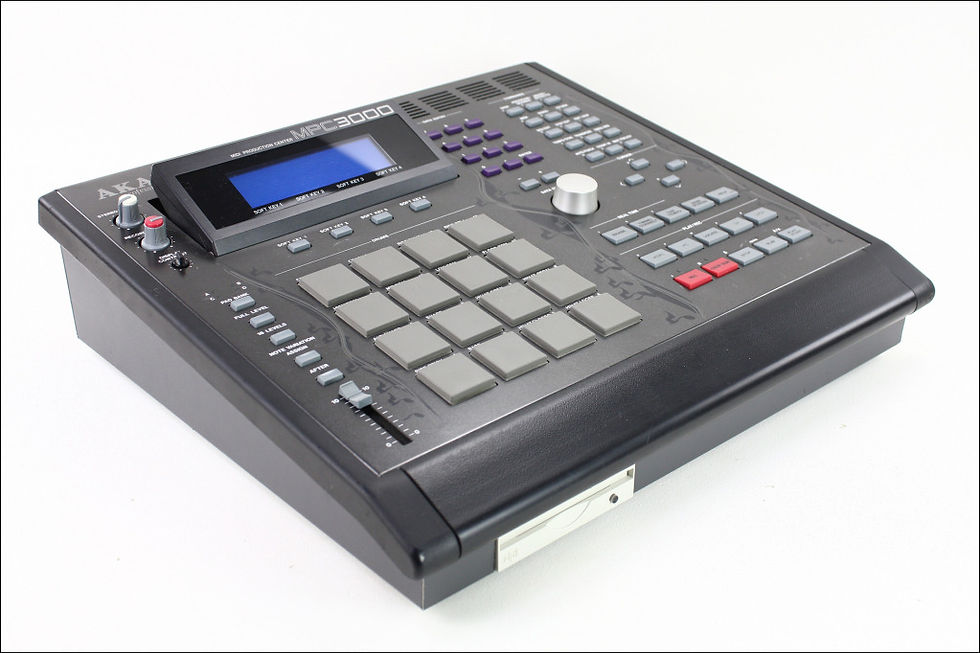
module. Most of my production was done using all the mentioned, including a Korg Triton module and a Roland JV-1080 synth module, which I had access to in the studio.
Riddims like Baddis, Grass Cyaat, Orgasm, Juice, and Gipsy were all created and mixed using analog equipment at Main Street Recording Studio in Kingston, Jamaica. The drum samples I used were a combination of sounds I received via floppy disk from either my uncle, Danny Brownie (Main Street Records), or my other uncle, Clevie (Steely & Clevie). I also sampled some drum sounds directly from two-inch tapes that clients left in the studio. I had all the popular drum samples synonymous with Dancehall in my sound library. This was the most important part to me; once the drums were solid, the rest was like icing on the cake.

I began my transition to digital (Pro Tools) around 2003, and by 2005, I had started working solely “in the box.”
The convenience of having everything I needed in one place was the main selling point. Everything was easy to recall, undo, copy, and paste. This saved time when tracking or recording, especially vocals. And unlike analog recording, I preferred digital recording for vocals because whatever I recorded is exactly what I get back—no tape noise, no hissing, no frequencies lost. And any warmth lost on bass or drums during digital recording can be easily recreated with plugins, so it’s a win-win.

All my recent dancehall productions have been recorded and mixed using Pro Tools. Some of my reggae works, like 'Million Reasons (Reggae Cover)' by Alaine and Shams the Producer, are recorded with live musicians, processing their line signals through outboard gear before recording in Pro Tools. This process enables you to achieve the precise tones of each instrument, reducing the need for EQ adjustments during the mixing process.
Over the years, I’ve used the drag-and-drop and snap-to-grid drum sequencing method when making beats, but I still prefer the MPC platform. I recently purchased the MPC One+, and it reminds me of my MPC 3000. Unlike the MPC Studio Black I bought three years ago, I believe I prefer stand-alone hardware. Plus, I’ve never really liked using a DAW for sequencing beats, especially drums. Call me

old school, but I love finger drumming. It’s like playing my bass guitar or keyboards. The inspiration flows from my body to my hands and fingers. A mouse and keyboard can never replace that.
My current go-to soft-synth is Xpand!2, a plugin instrument from Avid (Pro Tools). I also use synths and synth loops from Logic Pro X. However, any tracks created in Logic Pro are always transferred into Pro Tools for additional tweaking and mixing.
My mixing and mastering workflow deserves its own blog. Let me know in the comments if you’re interested. One thing I will mention is that the ability to recall mixes makes working in the box both convenient and a hindrance to productivity (those who know, will know what I’m talking about).
The truth is, it’s never about the equipment; it’s about the person using it. We all have the gift of creativity, which manifests itself in different ways, unique to each individual.
Now you know what Shams the Producer, dancehall music production toolbox looks like,
What do you use? Or, what’s your preferred workflow?
Please let me know in the comments, and if you found value here, I would appreciate it if you could share.
Thank you for stopping by.


Comments